


July 15, 2026
On the alluvial plain of the Yangtze River Delta, where waterways form a dense network, Shanghai supports nearly 25 million residents on less than one‑thousandth of China’s total land area, placing sustained pressure on the city’s water environment. Thanks to a systematic approach to environmental management, 99.3% of the city’s monitored surface water now meets or exceeds Class III quality standards.[1] Yet several inner-city waterways continue to face persistent challenges, shaped by complex hydrological conditions, diverse pollution sources and the interwoven nature of land and water spaces.
This challenge is now being addressed through the WIPO GREEN Acceleration Project. As the project’s local implementing agency in Shanghai, the Green Technology Bank identified the city’s specific needs and matched them with technological solutions, enabling the successful deployment of a technology for river water quality improvement based on high-throughput flat-plate plasma. This technology creates tiny reactive bubbles that “burn away” pollution in water at a microscopic level (see explanatory illustration). Building on its proven effectiveness in static water bodies, the technology is now being tested in river environments to confirm its applicability under continuous flow conditions. This expansion of its use has the potential to create a new pathway for improving water quality in the city’s central river channels.
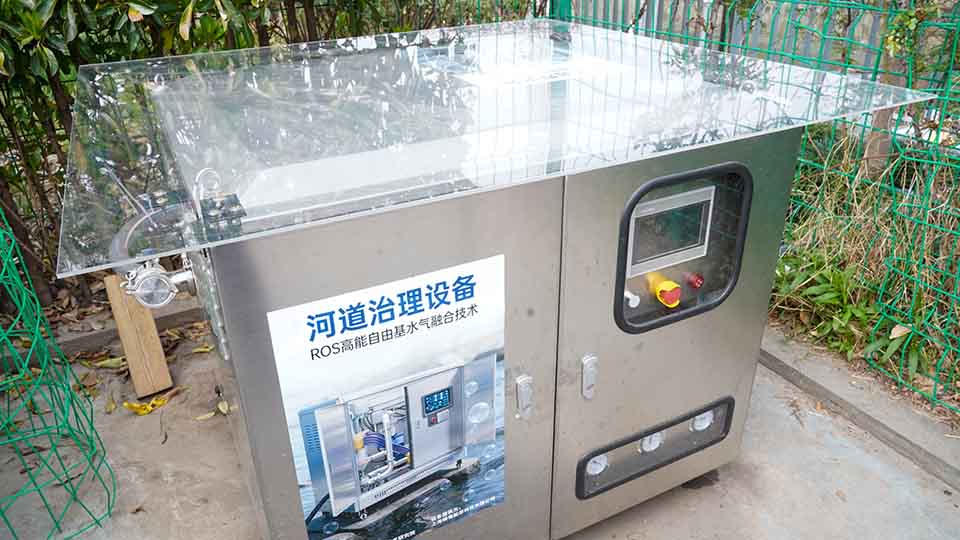 The plasma technology device in operation. Image: Green Technology Bank
Drawing on the WIPO GREEN Database of Innovative Technologies and Needs and the Green Technology Bank’s own evaluation system, the project team conducted multiple rounds of screening and verification before identifying the aforementioned technology as the most potential suitable solution. The technology pioneers a low‑temperature plasma water–air fusion process, requiring no chemical additives while preventing secondary pollution, offering clear operational advantages. The core equipment has now been installed at the Pengyuepu Sanitation Pier and is already in operation.
As a third‑party platform for scenario identification and technology validation, the Green Technology Bank worked with Shanghai Qiyuan Energy Technology Co., Ltd. to design and verify the technical solution, develop equipment tailored to real‑world needs and complete on‑site deployment. This formed an efficient collaboration chain linking WIPO GREEN with a local think tank and industrial entities, significantly accelerating the transition of green technologies from laboratory research to practical application.
The project is now running continuous tests from March to October 2026, with regular sampling and analysis of water quality to track the degradation of organic pollutants, heavy metals and other persistent contaminants in the river. This 8‑month testing period was selected to capture the season when water quality is at its worst, allowing performance to be assessed under the most challenging conditions. The results will be compared with data from the pier’s existing water‑quality monitoring station, enabling a systematic assessment of the technology’s effectiveness.
 Installation of the submersible pump water intake system in the river. Image: Green Technology Bank
While a full cost assessment over the 8‑month period is still underway, preliminary indications suggest that operational energy costs are relatively moderate in the Chinese context. Although the current equipment investment remains a constraint, this also highlights a strong opportunity for further optimization and cost reduction as the technology advances.
The successful implementation of this project reflects the core mechanism of the WIPO GREEN Acceleration Project, - demand‑driven, matched and locally deployed. As one of the WIPO GREEN Acceleration Projects implemented in China, the Shanghai initiative not only focuses on addressing local environmental challenges but also aims to provide validated green technology solutions for cities worldwide. This case has been included in the WIPO GREEN Database, where it will contribute “Shanghai’s experience” to other cities facing similar issues.
[1] “Report on the Surface Water Environmental Quality Status of Each District in Shanghai in December 2024 and for the Year 2024", published by the Shanghai Municipal Ecology and Environment Bureau.