


November 5, 2026
From cosmetics to processed foods, palm oil is found in products used every day around the world.[1] Indonesia plays a leading role in the global palm oil market; however, the sector also faces significant environmental challenges. With funding from the Australian Government through Funds-in-Trust Australia, a pilot composting plant has been deployed as part of a WIPO GREEN Acceleration Project. The project explores how palm oil mill waste can be transformed into a valuable resource, supporting greenhouse gas emission reduction efforts and a more circular economy.

Addressing the Challenge
According to a SEI publication, between 2015 and 2022, Indonesia's industrial palm oil production emitted an average of 220 million tons of carbon dioxide equivalent (CO₂e) emissions per year, primarily from peat fires and land-use change.
Palm oil processing also produces large volumes of liquid and solid waste. Palm Oil Mill Effluent (POME), a liquid by-product, is commonly stored in open ponds, where the decomposition of organic matter generates methane (CH4) emissions and can contribute to water pollution. Empty fruit bunches (EFB), a solid by-product, are often left to decompose before being returned to plantations as fertilizer. However, this process can be slow and requires significant space. EFB incineration offers a faster alternative but contributes to CO₂ emissions and air pollution. These mill-level emissions further highlight the importance of waste management practices and mitigation strategies.
Together, these challenges underscore the importance of improving waste management practices at the mill level and identifying solutions that can convert by-products into useful resources.
Since 2021, WIPO GREEN and Winrock International have worked together through WIPO GREEN Acceleration Projects to promote the adoption of sustainable technologies in Indonesia’s palm oil sector. Through several phases, the collaboration has focused on identifying solutions and connecting technology providers with local stakeholders in relation to reducing CH4 emissions from POME.
One early outcome was a match identified by Winrock International in 2021 among a palm oil mill, a technology provider and an organic fertilizer distributor, as featured in the article "Three Interconnected Matches Accelerating Sustainability in the Indonesian Palm Oil Sector." Although the initial collaboration encountered challenges related to compost supply and fertilizer commercialization, it provided valuable insights about the EFB aerobic decomposition system.
Another outcome was the development of a catalog of advanced technologies for the treatment and valorization of POME. The catalog provides information on available technologies such as biogas utilization, sludge and scum treatment, compost and fertilizer production and biochar production. It also includes information on technology suppliers and investment requirements, helping palm oil mills evaluate and implement suitable solutions.
Building on these earlier phases, the collaboration moved from technology identification to field deployment under a partnership agreement signed in 2025. Lessons from previous matches helped shape the pilot project, which led to the installation of a pilot composting plant in East Kalimantan in March 2026. The initiative brought together stakeholders across the value chain, from the technology provider to the end-user.
At the heart of the initiative was a straightforward idea: reducing greenhouse gas (GHG) emissions by transforming waste into a useful resource. By converting POME and EFB, traditionally seen as by-products, into compost, the initiative could support soil health, promote a more circular use of resources and contribute to sustainable agricultural production while decreasing GHG emissions.
Bringing technology from the laboratory to real-world application requires more than identifying a promising solution. For this pilot project, the process involved laboratory testing, stakeholder engagement, site preparation, technology installation and ongoing monitoring.
The project began with a search for the most suitable technology to convert EFB and POME into compost. Winrock International conducted a series of laboratory tests to evaluate different EFB aerobic decomposition systems using microbial decomposers, nutrient blends and POME. In the composting process, POME plays an important role by providing the moisture and nutrients needed to support microbial activity and accelerate the decomposition of EFB.
Among the technologies assessed, the solution developed by PT Indmira, previously identified through the WIPO GREEN Acceleration Project, stood out for its ability to decompose EFB, produce quality compost and meet the operational cost expectations of end users.
Once the technology provider was reached, the next step was to assemble the partners needed for deployment. Following discussions with palm oil mills of different sizes, Winrock International engaged with Trubus Sentra Agribisnis (TSA) as the project host and compost taker. PT Cahaya Bintang Sawit Sejati contributes to the project as the feedstock supplier, providing EFB and POME to TSA.
Partnership agreements among Winrock International, PT Indmira and TSA established the framework for implementing the pilot composting plant.
Before composting activities could begin, Winrock International and TSA worked together to prepare the site and install the infrastructure required to operate and monitor the technology. This included land preparation, the installation of equipment and POME distribution systems, the establishment of drainage and utility infrastructure and the preparation of raw materials, including EFB, POME, decomposers and nutrient blends.
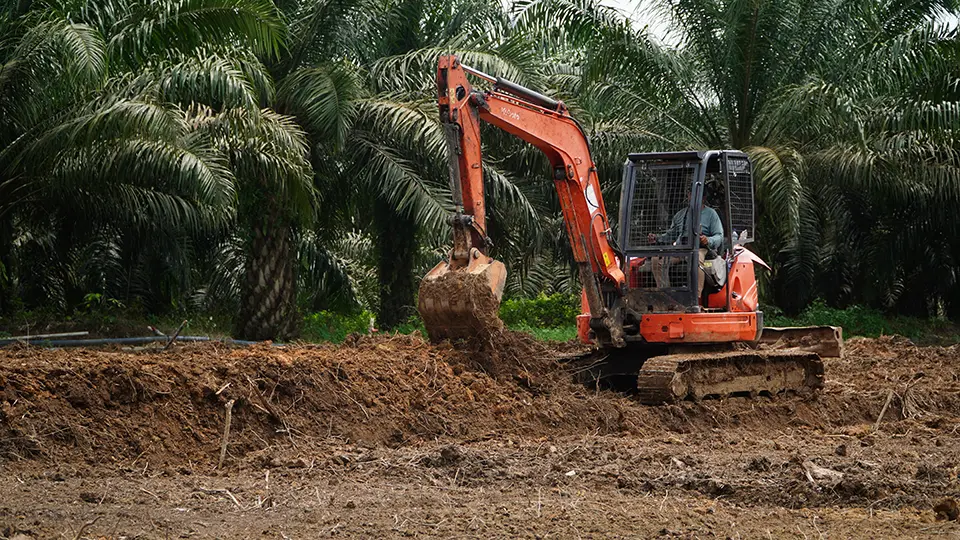
As with many first-of-their-kind deployments, the project faced a number of practical challenges during implementation. Soil compaction, pipe breakage and delays in material delivery were among the issues identified during commissioning. The project partners worked together to resolve these challenges, enabling composting operations to begin successfully.
Because the pilot aims both to deploy a technology and to determine the most effective composting approach, an experimental design was developed to evaluate different operating conditions and compare the identified decomposer technology with a control treatment and two commercially available products. Variables such as the decomposer volume and type, the use of chopped versus unchopped EFB, sheltered or unsheltered conditions and turning practices are being evaluated to help optimize the composting process and improve its performance under local conditions.
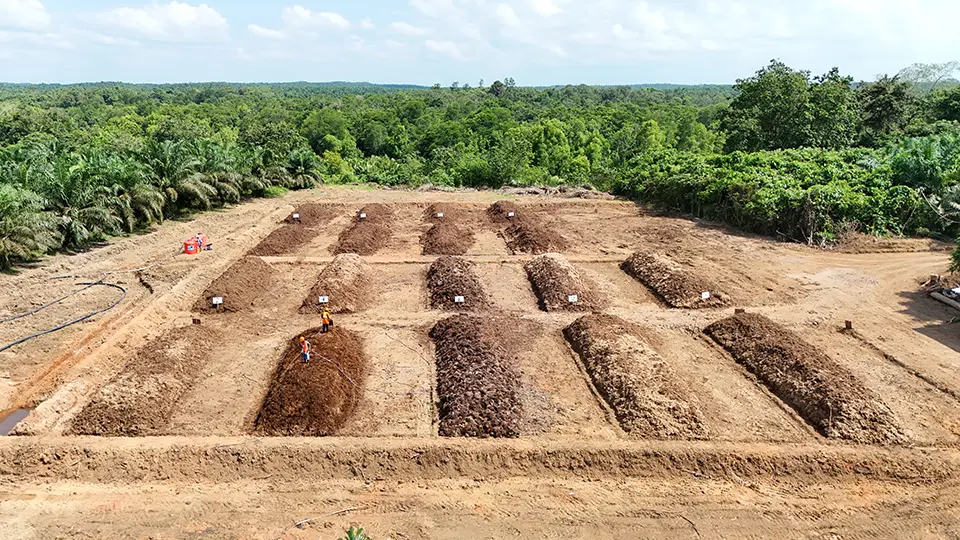
The first composting batch began on April 9, 2026, marking an important milestone in the pilot’s implementation. The process combines EFB, POME, microbial decomposers and nutrient blends to create the conditions needed for rapid organic decomposition.
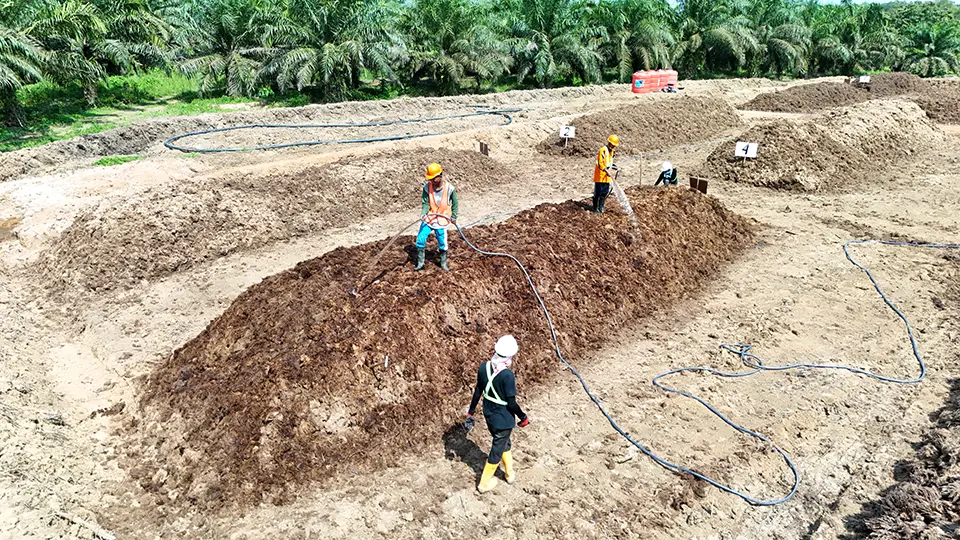
Throughout the process, the compost piles are regularly maintained and monitored to ensure optimal moisture levels, microbial activity and compost quality. Parameters such as moisture, temperature, pH, nutrient content and carbon-to-nitrogen ratio are tracked alongside environmental conditions including rainfall, temperature and humidity. The quality of the POME used in the process is also monitored.
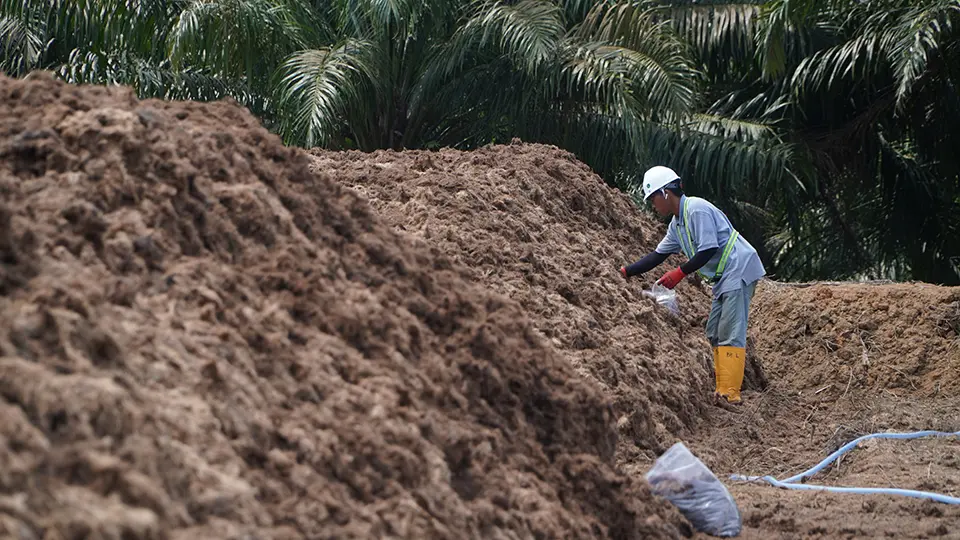
The project benefits from the support of Gadjah Mada University (UGM), a state university in Indonesia. Through its Faculty of Agriculture, UGM provides scientific expertise in areas such as microbiology and soil science, as well as laboratory facilities for the analysis and monitoring of the EFB composting process.
Across the first three composting batches, Winrock International and TSA teams continue to refine the process and identify the most effective operating conditions to accelerate decomposition while maintaining a high-quality final product.
Beyond technology deployment, the project places strong emphasis on measuring results. A dedicated Monitoring and Evaluation framework has been established to assess technical performance, environmental outcomes and broader socioeconomic benefits.
As implementation progresses, data is being collected to assess the potential of the composting system to reduce GHG emissions associated with conventional waste management practices. In particular, the project will continue evaluating the contribution of composting to reducing CH4 emissions from POME storage, avoiding emissions linked to EFB incineration and lowering emissions associated with the use of inorganic fertilizers.
The pilot demonstrates how collaboration can transform an environmental challenge into an economic and agricultural opportunity. A key objective has been to produce high-quality compost that meets the standards set by Indonesia’s Ministry of Agriculture, supporting its adoption as a sustainable organic fertilizer by farmers. Meeting these standards could strengthen stakeholder confidence and support the wider deployment of similar solutions across the palm oil sector.
"We hope this pilot project will provide strong evidence of the environmental and economic benefits of composting palm oil mill waste. Beyond reducing emissions and improving soil health, the initiative demonstrates how materials that were once considered a disposal challenge can be transformed into a valuable resource, creating additional value for the mill and supporting a more circular and sustainable palm oil sector. If successful, we believe this approach could encourage wider adoption of similar solutions across the industry." – Hari Yuwono, Team Leader, Winrock International
Building on several years of collaboration and technology matchmaking, the pilot project demonstrates how technology deployment can help bridge the gap between innovation and implementation, paving the way for more sustainable practices in Indonesia's palm oil sector.